
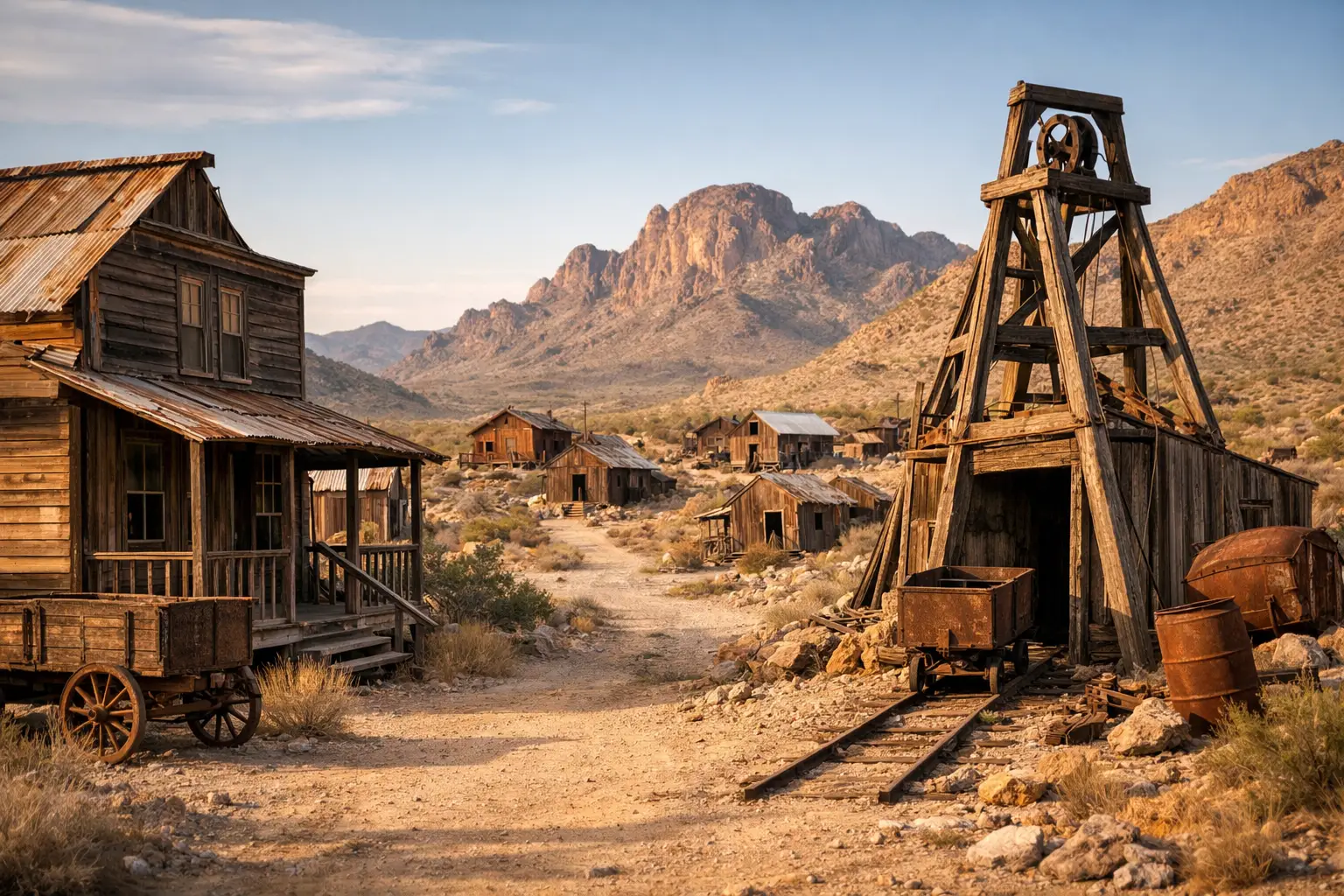
A rusted tin roof rattles in the wind. A row of empty windows stares across a dry wash. Somewhere beneath the dust, a bottle cap, a square nail, or a broken piece of china waits to tell its story. Abandoned mining towns history is not just about old buildings. It is about people who arrived with hope, worked in dangerous places, built busy communities, and sometimes watched those communities disappear.
For a Junior Investigator, a ghost town is not a movie set. It is a real-life mystery scene. Every weathered board and silent mine shaft raises a question: Who lived here? What did they want? And why did they leave?
Why Mining Towns Appeared So Quickly
In the American West, a rumor could change a landscape almost overnight. Someone found gold in a creek bed, silver in a mountain seam, or copper beneath rocky ground. Word spread through newspapers, letters, railroad stations, and crowded saloons. Prospectors came first, carrying picks, shovels, bedrolls, and big plans.
If the discovery looked promising, a camp formed. Tents became shacks. Shacks became stores, boarding houses, blacksmith shops, schools, churches, and hotels. A mining camp could grow into a town faster than anyone expected. Some places had newspapers, theaters, post offices, and busy main streets within a few years.
But mining towns were built around one difficult question: Could the mine keep producing valuable ore? If the answer changed, the town’s future could change with it.
Arizona has plenty of examples because its mountains and deserts contain rich deposits of copper, gold, silver, lead, and other minerals. Towns such as Jerome grew around mining, while smaller camps appeared in remote country where water was scarce and roads were rough. Life could be exciting, but it was rarely easy.
The Work Behind the Boom
Old ghost-town photographs sometimes make mining life look adventurous. The truth was tougher. Miners worked underground in cramped, dark spaces. They dealt with dust, falling rock, blasting accidents, heat, and long shifts. Above ground, families had to find water, cook meals, care for children, and survive harsh summers or cold mountain winters.
A mine also needed more than miners. It needed teamsters to haul supplies, carpenters to build homes, cooks to feed workers, merchants to stock stores, teachers to run schools, and doctors to treat injuries. That is why a mining town was a community, not simply a hole in the ground.
There is another part of the story that should not be left buried. Many mining districts were developed on or near the homelands of Indigenous peoples, whose communities already knew these landscapes deeply. Mining brought new roads, fences, pollution, and pressure on water sources. A careful history asks whose land was changed, not only who struck it rich.
Abandoned Mining Towns History: Why Places Went Silent
Most mining towns did not empty because of a single ghostly event, although legends often make it sound that way. Usually, several problems arrived at once.
The ore might run out, or it might become too expensive to reach. A mine could flood. A fire could destroy a business district. A railroad might choose a different route, leaving a town cut off from supplies and customers. When metal prices dropped, companies closed mines that no longer made enough money. Sometimes a new technology made an older operation unprofitable.
Water mattered, too. In the Southwest, a town without a reliable water source was always in danger. Drought could make daily life harder. A remote camp might lose residents simply because another place offered better jobs, safer homes, or a school closer to family.
That does not mean everyone fled in one dramatic night. Some residents moved away slowly. A store closed, then the school. A few families stayed. Buildings were reused, torn down for lumber, or carried away piece by piece. Over decades, wind and rain did the rest.
The word “abandoned” can be misleading. Some former mining towns are completely empty. Others are preserved historic sites, private property, or living communities with mining-era buildings still standing. Jerome, for example, was once close to becoming a ghost town after its major mines closed, but it found a new life through art, tourism, and preservation. History does not always end where the mine does.
What the Ruins Can Tell Us
A ghost town is full of clues, but the best clues are often ordinary. The size of a foundation can suggest whether a building was a home, a store, or a public hall. A cluster of fruit trees may mark where families once lived. Old roadbeds reveal how supplies reached a camp. A cemetery can show the names, ages, origins, and hardships of the people who made up the town.
Even the town’s location is evidence. Was it close to a rail line? Was it tucked into a canyon near a mine opening? Did it sit beside a spring? Investigators look at geography because geography shaped everything: food, transportation, work, safety, and survival.
Newspaper records, maps, census pages, photographs, and family letters can fill in what ruins cannot say aloud. A photograph may show a crowded street where only weeds grow now. A newspaper might report a dance, a mine strike, a flood, or a baseball game. Suddenly, a silent place becomes a place full of voices.
That is one reason ghost towns feel so mysterious. They hold evidence of everyday life, but not the whole story. The missing pieces invite imagination. They also demand respect.
Real History and Ghost Stories
Mining communities produced plenty of legends. People told stories about hidden payrolls, lost mine tunnels, unlucky claims, strange lights, and spirits that refused to leave. Some tales may have grown from real accidents or unexplained events. Others were likely campfire stories that became more dramatic with every retelling.
That does not make folklore worthless. Legends can reveal what people feared, hoped for, or wanted others to remember. A tale about buried gold may point to a genuine boom period. A story about a haunted hotel may preserve the memory of a fire, a tragedy, or a well-known local character.
The trick is to keep two notebooks in your mind. One is for documented facts: dates, records, maps, and firsthand accounts. The other is for legends: stories that may not be proven but still belong to a place’s character. Both can be fascinating. They are simply different kinds of clues.
How to Investigate a Mining Town Respectfully
The most important rule is simple: do not enter unsafe ruins or mine shafts. Old mines can collapse without warning, and deep openings may be hidden by brush or loose boards. Historic structures can contain broken glass, unstable floors, nails, and wildlife. The safest view is often from a marked trail or public overlook.
Never assume a ghost town is open to visitors. Many sites sit on private land, tribal land, active mining claims, or protected public land with specific rules. Take photographs instead of souvenirs. Removing artifacts erases clues that future visitors, historians, and archaeologists may need.
A strong investigation can happen before you ever leave home. Compare an old map with a modern one. Look for the town’s water source and rail connection. Search for the mine’s name in historical records. Then write down a question worth chasing, such as: What made this town grow, and what made it fade?
If you do visit a legal, open historic site with a parent, guardian, teacher, or group leader, bring water, sun protection, a notebook, and patience. The desert does not give up its stories quickly. Sometimes the biggest discovery is noticing that a line of stones was once a foundation, or that a quiet hill holds a cemetery overlooking the town.
The Ghostly Legends Society believes that mysteries become better when you investigate them carefully. Not everything in the desert stays buried, but some things should stay exactly where they are. Leave the artifact. Record the clue. Let the next investigator find the same question waiting in the dust.
Leave a Reply