
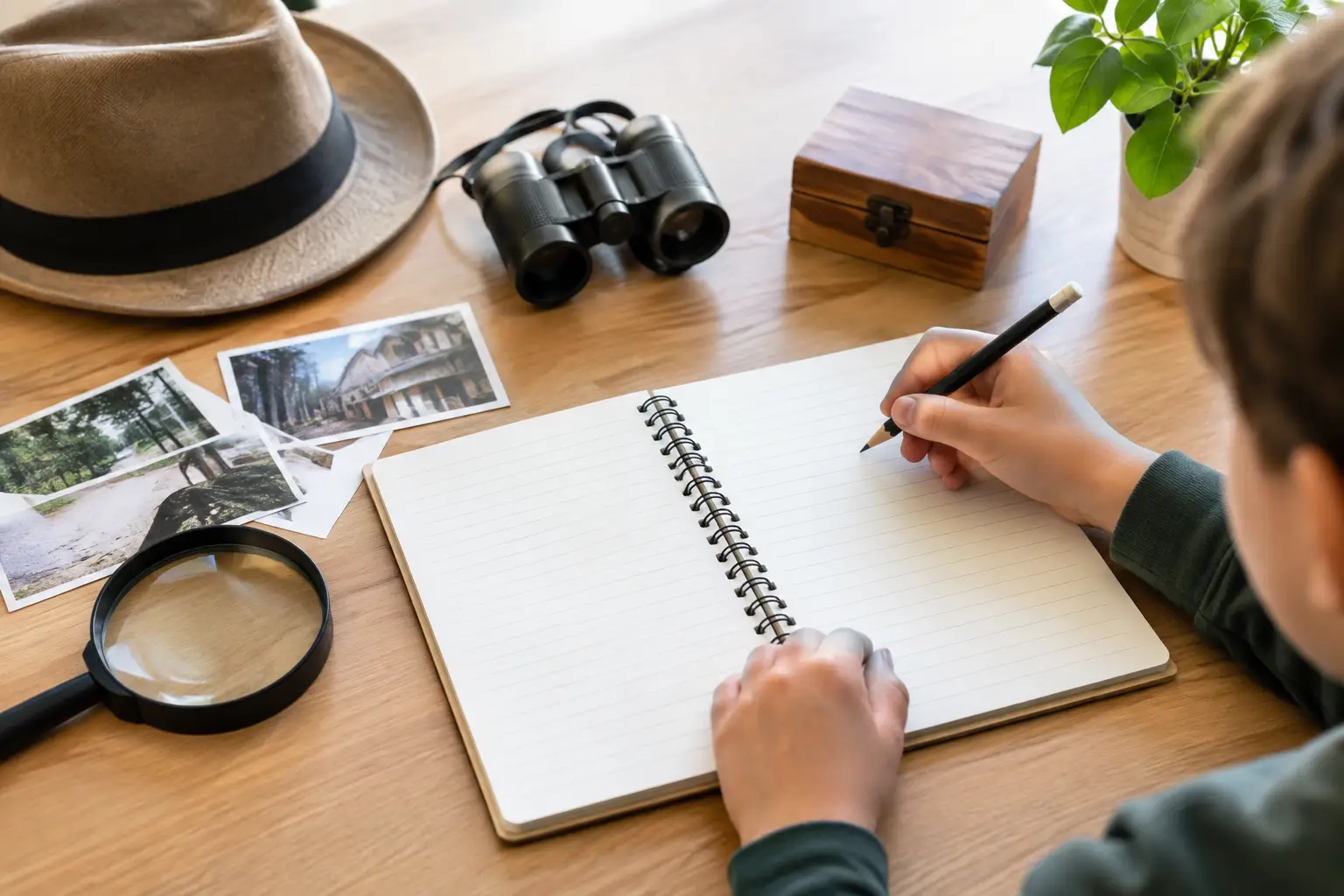
A good mystery can begin with one odd detail: a boot print beside a dry creek bed, a light in an abandoned window, or an old map with a trail that stops too suddenly. That is where clue journal ideas become more than school notebook pages. They become the record of an investigation.
A clue journal is a place to think like a detective, historian, and explorer all at once. Young investigators can use one while reading a mystery, researching a local legend, hiking with family, or inventing a case of their own. The goal is not to make every page perfect. The goal is to notice what others might miss.
Choose a notebook that feels ready for fieldwork. A plain composition book works. So does a spiral notebook with a sturdy cover. Add a pencil, a few colored pencils, and perhaps a small envelope for safe keeping of harmless discoveries like pressed leaves, copied maps, or ticket stubs. Then give the journal a name. Every official investigation needs a case file.
Clue Journal Ideas That Start a Real Case
Begin each new investigation on a fresh page with a case title, date, location, and weather. Weather may sound like a small detail, but it changes tracks, shadows, sounds, and what people remember seeing. A windy night in the Superstition Mountains feels very different from a still one.
Here are twelve pages worth adding to a clue journal. Use all of them for a big mystery, or choose a few for a quick investigation after school.
1. The Case Cover Page
Give the mystery a title that raises a question. “The Missing Camp Lantern,” “The Whispering Hallway,” or “The Map with No Mine” are better than “Mystery Stuff.” Under the title, write one sentence explaining what needs to be discovered. This keeps the case focused when clues begin piling up.
Leave room for a case status stamp: Open, Uncertain, Solved, or Still Watching. Some legends refuse to close their files.
2. The First Strange Thing
Every case has a beginning. Describe the first unusual event in as much detail as possible. What happened? Who noticed it? What time was it? What did the place look, sound, and smell like?
Separate observations from guesses. “There were three muddy footprints near the gate” is an observation. “A ghost left them” is a theory. Both belong in the journal, but they should not be confused. Detectives earn better answers by knowing the difference.
3. A Map of the Scene
You do not need to be an expert artist to draw a useful map. Sketch the trail, room, park, neighborhood block, or imaginary ghost town where the mystery happened. Mark doors, trees, fences, rocks, washes, and anything else that might matter.
Use a simple key. A star can show where an object was found. Arrows can show the direction someone traveled. A question mark can mark a place that needs another look. If you are exploring outdoors, stay on marked paths and investigate only with a trusted adult.
4. The Clue Inventory
Make a numbered record of every clue. For each item, include where it was found, when it was found, and why it might matter. A torn paper scrap might be nothing. Or it might match a note discovered later.
Avoid touching or collecting objects that could be dangerous, sharp, old, or privately owned. A journal entry, sketch, or photo taken with permission is often all an investigator needs. Real history deserves careful hands.
5. Witness Notes
A witness could be a friend, a grandparent, a park ranger, a librarian, or someone who remembers a local story. Write down their exact words when possible. If they say, “My uncle always warned us about lights near the old mine road,” put quotation marks around it.
Then add a second line: What does this person know firsthand, and what did they hear from someone else? Folklore often travels by word of mouth. That does not make it useless. It tells you how a legend has changed and why people kept telling it.
6. Suspect and Creature Profiles
Not every mystery has a villain. Sometimes the “suspect” is a storm, a loose window latch, a misplaced key, or a very determined raccoon. Create a profile for every possible explanation.
If your case involves a cryptid legend, record the reported description without declaring it true too soon. How tall was it said to be? What sounds were heard? Were there tracks, or only a shadow at dusk? Strange stories deserve open minds and careful questions.
7. Timeline of Events
Mysteries get harder when events are out of order. Draw a line across a page and place each known event where it belongs. Start with the last ordinary moment. Then add the discovery, witness reports, searches, and new evidence.
A timeline can expose missing time. If the lantern disappeared at 7:00 p.m. but everyone says they saw it at 7:30, someone may be mistaken. That does not mean they are lying. Memories can be slippery, especially when a story is exciting.
8. Legend Research Page
This is where a clue journal turns into a history journal, too. Choose one local tale, historic place, or unexplained story connected to the case. Record what is known, what is rumored, and what questions remain.
For Arizona investigators, that might mean comparing different versions of the Lost Dutchman’s Gold legend or noting how ghost towns formed after mining booms faded. In the Ghostly Legends Society, old stories are never just background. They are trails leading toward the next question.
9. Sketches, Symbols, and Codes
Some clues are easier to understand when drawn. Sketch a footprint beside a ruler measurement, copy an unusual symbol, or illustrate the shape of a rock formation. Label every drawing with the date and place.
You can also invent a simple code for private story ideas. Keep it friendly and use it only for games, journals, and fictional cases. The best secret codes make a mystery more fun, not harder for people to trust one another.
10. Theory Board
Dedicate one page to possible answers. Write each theory as a complete sentence: “The sound came from wind moving through the old vent.” Then list evidence for it and evidence against it.
This page is allowed to change. In fact, it should. A smart investigator is not the person who guesses first. It is the person willing to revise a guess when a new clue appears.
11. Questions for the Next Search
A case moves forward because someone asks a better question. Before the next walk, library visit, or conversation, write three questions you want to answer. Maybe you need to know whether the trail existed on older maps, who owned a building long ago, or whether an animal could make the tracks you found.
Specific questions prevent random searching. They also make research feel like an expedition with a destination, even when the answer turns out to be stranger than expected.
12. The Case Closing Report
When you think the investigation is finished, write a final report. Explain what happened, which clues mattered most, and what remains uncertain. If there is no complete answer, say so. “Unsolved” is not the same as “failed.”
Many real legends survive because no one can prove every part of the story. A careful closing report respects the mystery without inventing facts to force a neat ending.
Make Your Journal Feel Like Field Evidence
A clue journal works best when it looks used. Number the pages. Circle facts that need checking. Add a “return to this” flag beside details that seem small but keep bothering you. If you make a mistake, draw one line through it instead of tearing out the page. Investigations have false starts, and those false starts can reveal how your thinking changed.
For readers who love fiction, try keeping two sections. One is for real observations and local history. The other is for story evidence: character secrets, suspicious dialogue, possible treasure routes, and chapter-by-chapter predictions. A journal can make reading an adventure story feel like joining the team.
Parents and educators can use clue journals for low-pressure research, too. Ask young investigators to compare two versions of a legend, map the setting of a book, or write a witness interview with a historical figure. The point is not to turn every spooky tale into a report. It is to give curiosity somewhere to go.
The next time you hear a floorboard creak, find an odd mark in the dirt, or come across a tale that has been passed around for generations, reach for your journal before the moment disappears. Write down what you saw. Mark the place. Ask one more question. Somewhere between the known facts and the unexplained, a new case may already be waiting.
Leave a Reply