
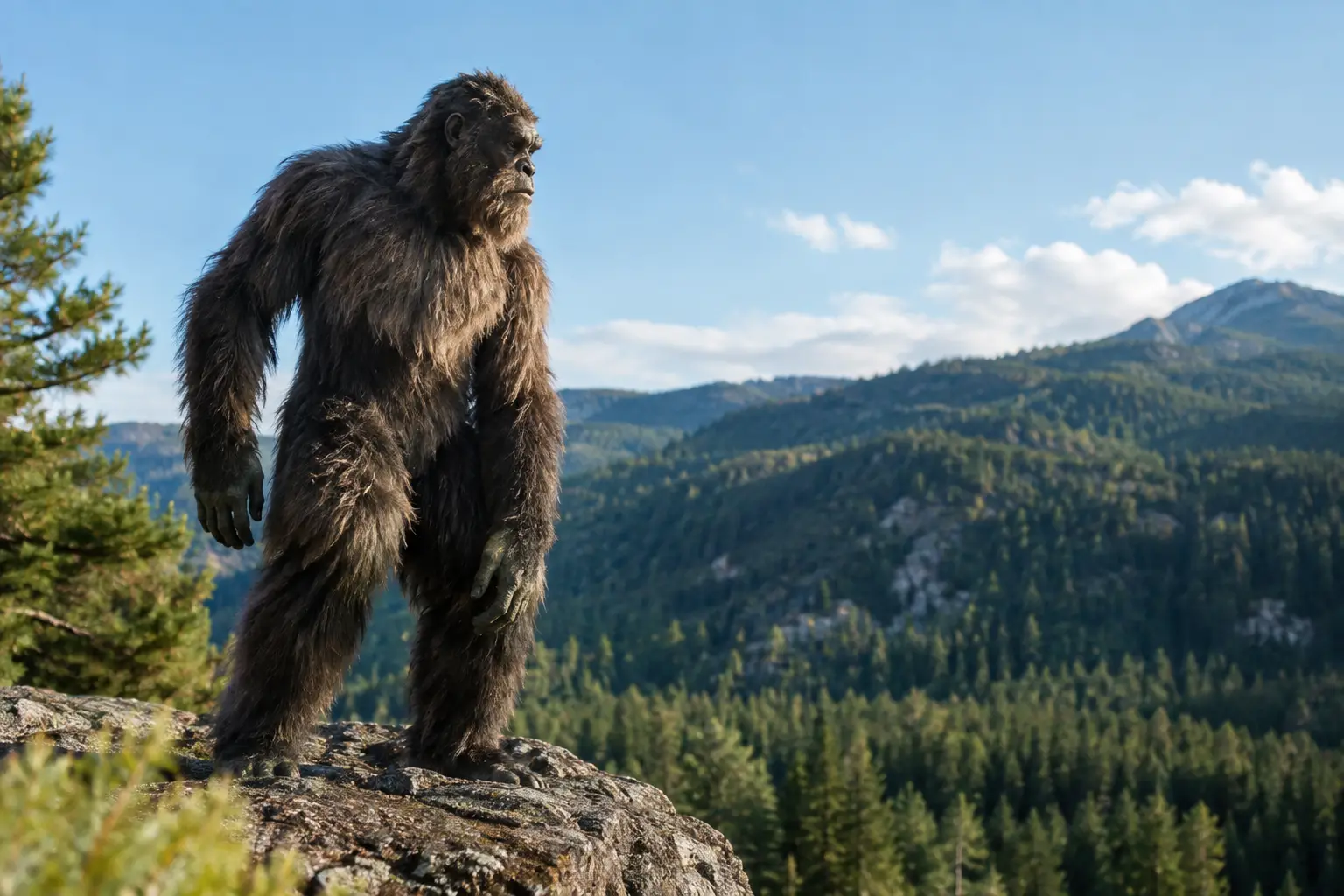
A branch snaps beyond the firelight. Something heavy moves through the ponderosa pines, then goes quiet. That is the question at the heart of the best Mogollon Monster story examples: what would you do if the wilderness gave you one clue too many to ignore?
The Mogollon Monster is Arizona’s own big, shadowy wilderness legend. Witnesses and storytellers have described a tall, hairy creature roaming the Mogollon Rim and nearby mountain country. Some accounts focus on huge footprints. Others describe a terrible smell, strange cries, or a figure slipping between the trees. None of these stories prove that an unknown creature lives in the forest. But they do reveal why this legend has lasted for generations.
For a Junior Investigator, the fun is not simply shouting, “Monster!” The real adventure is learning to separate a spooky report from a solid observation. What was seen? What was heard? What might have made it? And which detail still refuses to fit?
What Makes Mogollon Monster Stories So Chilling?
Arizona’s high country is a perfect setting for an unsolved legend. The landscape changes fast. One moment, you can see a blue sky above pine-covered slopes. The next, a canyon, storm cloud, or wall of trees can hide everything beyond a few yards. At night, elk bugle, coyotes call, and wind can make the forest sound crowded with unseen movement.
That does not mean every strange sound has an ordinary answer. It means a careful investigator starts there.
Most Mogollon Monster reports share a few familiar features: an enormous humanlike shape, dark or reddish-brown hair, a powerful odor, long strides, and a feeling that someone or something is watching from the woods. Details vary because witnesses see things in different weather, at different distances, and often in a rush of fear. Those differences are not a flaw in the legend. They are part of its mystery.
Mogollon Monster Story Examples From the Legend
The giant tracks beside the trail
Imagine hiking after a rainstorm and finding deep prints in soft earth. They are larger than your boot and seem to lead off the trail into a thicket. This is one of the most familiar types of Mogollon Monster story.
Tracks feel convincing because they are physical. You can measure them, photograph them, and follow them. But footprints are also easy to misread. A bear’s track can look surprisingly human when mud fills in the toe marks. A damaged print can stretch into a strange shape. Even two overlapping animal tracks can create a single giant-looking impression.
Still, the best version of this story does not end with one oversized print. It asks for a pattern. Are there several tracks? Do the strides make sense? Do they begin and end somewhere reasonable? Are there claw marks, hoof marks, or signs that the ground has been disturbed? One print is a puzzle. A clear trail of them is a much stronger clue.
The scream in the pines
Another classic example begins with sound. Campers hear a scream, a howl, or a deep call rolling across a canyon after dark. It does not sound like a wolf. It does not sound human, either. For a few long seconds, nobody at the campfire speaks.
This kind of report belongs in every investigator’s notebook, but it needs context. Foxes can make sharp, startling screams. Mountain lions can produce cries that sound almost like a person in trouble. Elk, coyotes, owls, and even echoing voices can become unrecognizable in the mountains.
The detail that makes a sound report interesting is not just that it was scary. It is how it behaved. Did it repeat at regular intervals? Did it answer another call from far away? Was there wind? Was the sound close, or did the canyon make it seem close? A spooky noise may have a natural explanation. Yet a careful description can turn a frightened memory into a clue worth comparing with other reports.
The figure that crossed the road
A driver rounds a bend on a quiet forest road and sees something standing at the edge of the headlights. It is tall. It appears covered in hair. Before the driver can stop, it takes a few long steps and vanishes into the trees.
Roadside sightings are among the most cinematic Mogollon Monster story examples because they happen so quickly. Headlights flash across brush, shadows bend over uneven ground, and a deer standing at an odd angle can look much larger than it is. A bear moving on its hind legs for a moment can also create a startling silhouette.
But speed does not erase every observation. A useful report records the time, weather, location, estimated distance, direction of travel, and what happened immediately before and after the sighting. Was there another witness in the vehicle? Did the creature leave tracks? Did the witness see ears, a tail, hands, or clothing? Those details matter more than a dramatic guess.
The smell that arrived before anything was seen
Some stories begin with no sighting at all. A hiker notices a strong, musky odor drifting through a ravine. It is described as wet fur, rotten leaves, or something sour and unfamiliar. Then the birds stop calling. Branches shake uphill. Whatever caused the disturbance is gone before anyone sees it.
A powerful smell can be memorable, but it is not a creature’s calling card. Decaying plants, a dead animal, skunks, javelinas, bears, and stagnant water can all create odors that seem strange in the moment. Wind can carry that smell from far away, making its source difficult to locate.
This example works so well in a mystery because it gives the characters a clue without an answer. They have evidence that something changed in the forest, but not enough evidence to name it. That gap is where the investigation begins.
Why the Details Matter More Than the Monster
Legends grow when people repeat the most dramatic parts. A ten-second sighting becomes a huge beast with glowing eyes. A muddy track becomes a footprint “as big as a dinner plate.” That is not necessarily dishonesty. Memory changes, especially when surprise and fear are involved.
A strong investigation respects the witness without treating every detail as fact. Start with what can be checked. Look for maps, weather conditions, animal activity, photographs, and other reports from the same area. Then leave room for uncertainty.
It depends on the evidence. A lone call in the dark is probably not enough to claim a monster. Several independent witnesses describing the same unusual event could be more interesting, especially if their reports were made before they heard one another’s stories. The goal is not to ruin a good legend. It is to make the mystery sharper.
Turning a Legend Into Your Own Investigation
If you were building a Mogollon Monster case file, begin with the setting. The Mogollon Rim is not an imaginary haunted forest. It is real Arizona country, filled with steep terrain, wildlife, old trails, and changing weather. Learning about the place makes any fictional adventure feel more thrilling because the danger and wonder have roots in a real landscape.
Create a field report for every strange event. Record the date, time, location, weather, sounds, smells, tracks, and possible ordinary explanations. Sketch what you saw before looking at anyone else’s drawing. If you are outdoors, stay with your group, tell an adult where you are going, and never follow an animal or unknown sound into the woods.
That same investigator mindset powers stories like Search for the Mogollon Monster. A mystery becomes more than a chase through dark trees when the characters must decide what evidence to trust, what secrets to protect, and whether the truth is safer left hidden.
The next time the wind moves through Arizona’s pines, listen closely. It may be an elk, a fox, or a branch rubbing against bark. Or it may be the beginning of a story that needs one more brave investigator to write down what happened.
Leave a Reply