
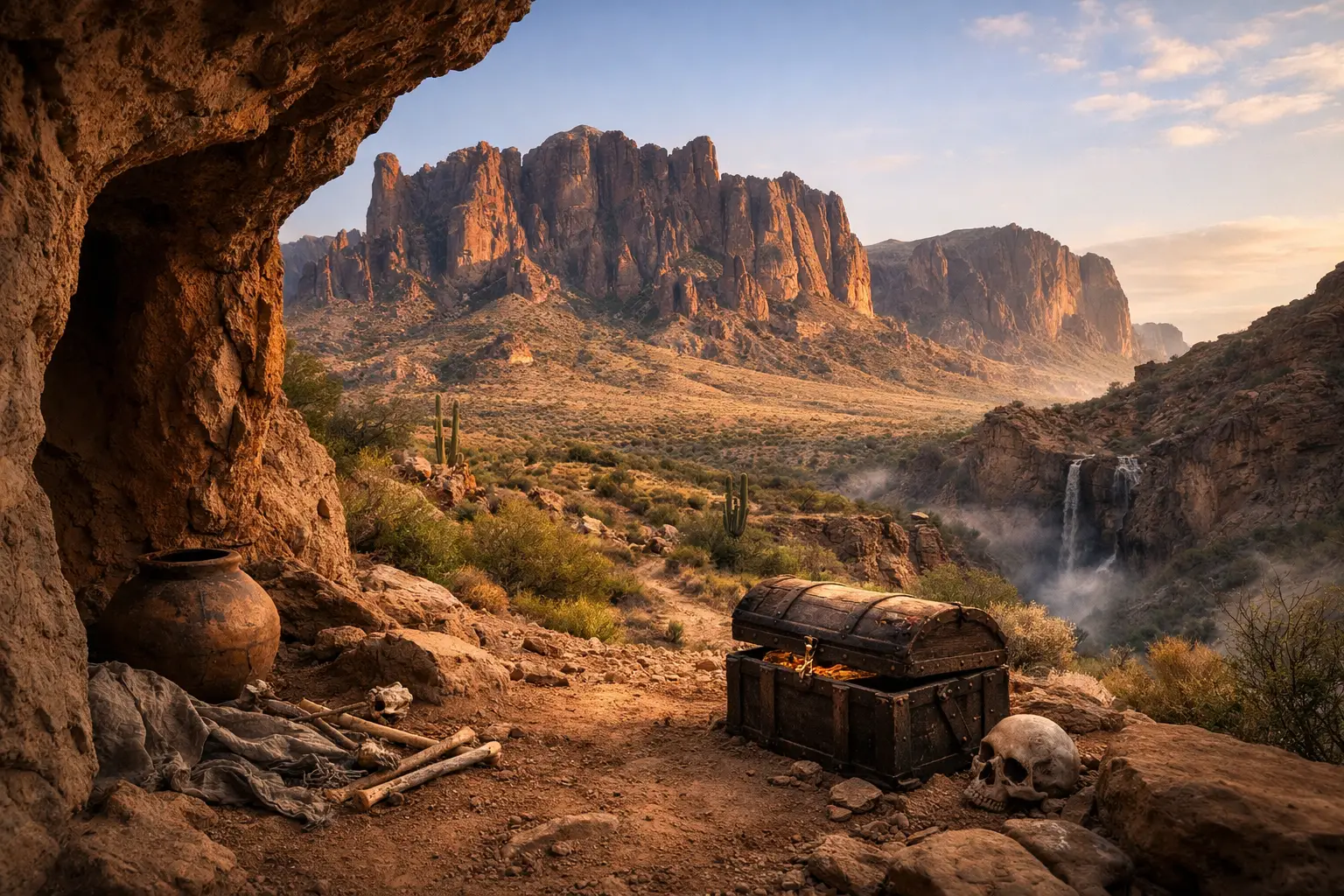
At dawn, the Superstition Mountains can look close enough to touch from the edge of Apache Junction. Then the sun rises, shadows pull away from the cliffs, and the canyons seem to multiply. That is where the Superstition Mountains hidden secrets begin: not with one proven treasure map, but with a wild tangle of real history, missing miners, ancient places, and stories that refuse to stay buried.
For a Junior Investigator, that is better than a simple answer. A mystery with one easy solution is over fast. A mystery built from clues, questions, and competing legends can last for generations.
The Mountain Range Is Real. The Secrets Are Complicated.
The Superstitions are a rugged wilderness east of Phoenix, Arizona. Their volcanic cliffs, narrow washes, and sharp ridges make them look like a fortress built by nature. Summer heat can be brutal, winter nights can turn cold, and a route that appears simple on a map may become confusing on the ground.
That difficult landscape helped build the legends. In a place where people can lose the trail, find an old mining claim, or hear unexplained sounds echoing through a canyon, imaginations get to work. But the mountains were not empty before prospectors arrived. Indigenous peoples have known, traveled through, and cared for this region for centuries. Their histories deserve respect, not treatment as props in a treasure hunt.
The first investigator rule is simple: separate the landscape from the legend without dismissing either one. The mountains are real. The danger is real. The stories may change with every telling, but they can still reveal what people feared, hoped for, and searched for here.
The Lost Dutchman’s Gold Mine
No legend is more closely tied to the range than the Lost Dutchman’s Gold Mine. The story usually centers on Jacob Waltz, a German immigrant often called the “Dutchman” because, long ago, many Americans mistakenly used that word for German speakers. According to popular versions of the tale, Waltz discovered a rich gold mine somewhere in the Superstitions and carried its location to his grave.
That sounds like the beginning of a perfect adventure story. It also raises immediate questions. Did Waltz truly find a fabulous mine? Did he only have a small claim or a cache of gold? Did later storytellers add dramatic details because a hidden mine makes a better tale than an ordinary prospector’s hard life?
The honest answer is that nobody has produced verified proof of the legendary mine. Gold was mined in Arizona, and prospecting was a real part of the territory’s history. Yet the exact Lost Dutchman mine remains unconfirmed. That uncertainty is the engine of the legend.
Over the years, searchers have brought maps, riddles, supposed deathbed clues, and very confident theories into the wilderness. Some believed the mine lay near Weaver’s Needle, the tall rock formation visible from many trails. Others insisted the clues pointed somewhere completely different. A good investigator notices a pattern: when every map leads to a different spot, the map may be telling more about its maker than about the gold.
Why the Superstition Mountains Keep Their Secrets
A hidden treasure is only one kind of secret. The Superstitions hold quieter mysteries too: abandoned routes, old homestead traces, weathered mining equipment, petroglyphs, and the stories attached to each feature.
Some sites are protected, fragile, or culturally significant. That means being a real investigator is not the same as being a treasure hunter. You do not scratch at rock art, enter closed mines, remove artifacts, or announce the location of a sensitive place. A photograph, a sketch, and careful research are far more valuable than taking an object that belongs to history.
There is another reason the mountains keep their secrets. Nature changes the evidence. Flash floods can reshape a wash in a single storm. Wind covers tracks. Rockslides block paths. Desert light plays tricks with distance, making a familiar landmark seem strange. A story that begins with, “I saw something over that ridge,” can become much larger by the time it reaches the next campfire.
That does not mean every account is false. It means eyewitness stories need context. When was it seen? From where? What was the weather like? Is there a photo, a document, or another witness? These are the questions that turn curious readers into careful detectives.
Ghost Stories, Strange Creatures, and Campfire Clues
The Lost Dutchman is not the only mystery in the range. People have reported eerie lights, strange noises, shadowy figures, and a feeling of being watched in remote canyons. Some tales mention ghostly miners guarding gold. Others connect the region to mysterious caves or creatures that vanish before anyone gets a clear look.
Most of these reports cannot be proven, and many have ordinary explanations. Wind can whistle through rock formations like a voice. A distant hiker’s flashlight can look like a floating light. Coyotes, owls, and other desert animals can make calls that sound unfamiliar at night.
Still, folklore matters. A ghost story can preserve memories of dangerous mine shafts. A creature tale can express the fear of being alone far from help. And sometimes a legend survives because it gives a place personality. The mountain becomes more than stone. It becomes a character with a long memory.
For readers who enjoy eerie Arizona mysteries, that is part of the fun behind The Ghostly Legends Society. The best adventures do not demand that you believe every rumor. They invite you to follow the clues and decide what the evidence can actually support.
How to Investigate Without Becoming Part of the Mystery
The Superstitions are not a backyard playground. Families and school groups can enjoy designated trails and visitor areas, but wilderness travel requires planning, adult supervision, and respect for posted rules. The goal is to come home with a great story, not to become the subject of a search-and-rescue report.
Before any outdoor investigation, build your case file around four habits:
- Check trail conditions, weather forecasts, and closure notices before leaving.
- Carry more water than you think you will need, plus sun protection, food, and a basic first-aid kit.
- Tell someone exactly where you are going and when you expect to return.
- Stay on established routes, never enter abandoned mines, and leave rocks, artifacts, plants, and wildlife where they belong.
The last rule can feel less thrilling than following a mysterious side path. But it is how real explorers protect themselves and protect the places they visit. A closed mine may contain bad air, hidden shafts, unstable timbers, or sudden drops. An old artifact may help historians understand the past only if it remains in its original location.
You can investigate from home, too. Compare older newspaper accounts with modern versions of the Lost Dutchman story. Mark different claimed mine locations on a map and notice how often they disagree. Keep a notebook with two columns: “known evidence” and “legend.” You may be surprised how quickly one exciting claim moves from one column to the other.
A Secret Does Not Have to Be Gold
Perhaps the biggest secret of the Superstition Mountains is why the legend lasts. Gold is part of it, certainly. So are ghosts, vanished trails, and the sharp silhouette of Weaver’s Needle against an Arizona sunset. But the deeper pull is the chance that a familiar map still has a blank space on it.
Maybe the mine was never found because it never existed as described. Maybe there was a small discovery that grew larger with every retelling. Maybe the real treasure is the history hiding in plain sight: the people who crossed this country, the families who worked its mines, the cultures connected to its land, and the warnings passed down around campfires.
So take your notebook. Ask better questions. Let the mountains keep what should stay protected, while you search for the clues that are safe to find. The next mystery may begin not beneath a pile of gold, but in one small detail everyone else overlooked.
Leave a Reply