
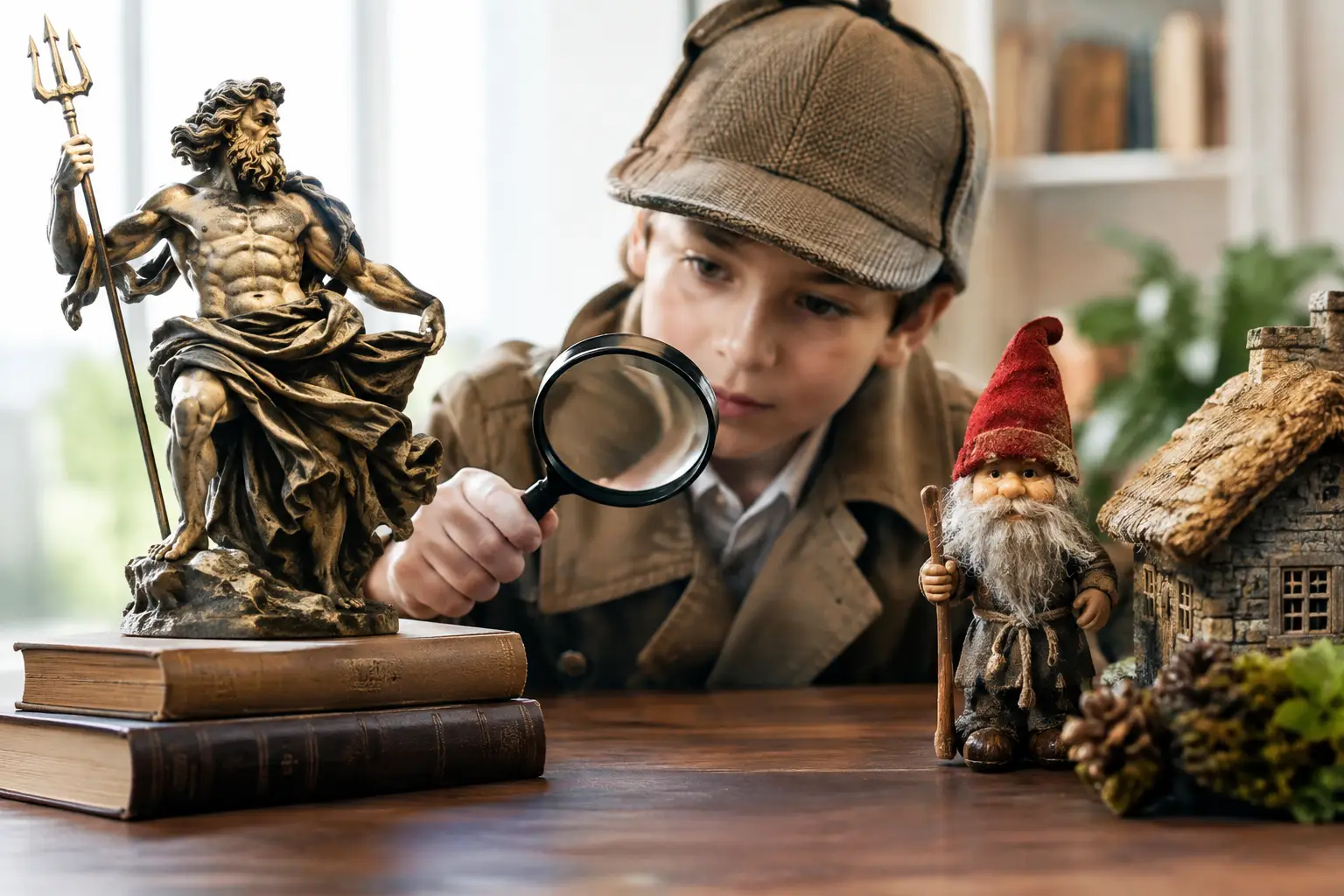
A strange shape crosses a mountain ridge. An old prospector vanishes while hunting gold. A thunder god throws a bolt from the clouds. These stories may all feel mysterious, but mythology versus folklore is not quite the same investigation. One often reaches toward the biggest questions people ask about the universe. The other may begin much closer to home – beside a campfire, along a desert trail, or in a town where someone swears the abandoned hotel is not empty.
Knowing the difference gives every young investigator a better set of clues. It helps you ask where a story came from, why people kept telling it, and what it meant to the people who carried it forward.
Mythology Versus Folklore: The Main Difference
Mythology is a collection of sacred or culturally meaningful traditional stories, often involving gods, powerful spirits, creation, heroes, and the forces that shape the world. These stories can explain why the seasons change, how death entered the world, where a people came from, or what duties humans have to one another.
Greek stories about Zeus, Athena, and Persephone are mythology. So are the traditional stories of many cultures around the world. They are not simply old-time entertainment. For the communities connected to them, they can hold beliefs, history, values, and identity. Calling every ancient story a “myth” can miss that meaning.
Folklore is the larger campfire circle. It includes the traditional tales, beliefs, sayings, customs, songs, games, superstitions, and creatures shared by a community. A legend about a haunted mine, a warning never to whistle after dark, a regional ghost story, and a recipe made the same way for generations can all be folklore.
That means mythology can be part of folklore. But folklore contains much more than mythology.
Think of it this way: mythology often asks, “How does the world work?” Folklore often asks, “What happens around here?” The answer is not always so neat, but it is a useful first clue.
A Case File for Mythology
Mythological stories usually operate on a grand scale. The characters may be gods, culture heroes, supernatural beings, or ancestors whose choices affect an entire people or even the whole world. A myth might explain the origin of fire, a sacred animal, a mountain, or a rule that guides a community.
These stories also tend to have deep connections to ceremonies, religious beliefs, or cultural traditions. They are passed down because they matter, not merely because they are thrilling. A giant serpent in a creation story may represent much more than a monster. It may carry lessons about water, danger, responsibility, or the relationship between people and the land.
That is why an investigator should use respectful language. Different communities may have their own names for their traditional stories and may not call them mythology at all. Some stories are shared publicly; others are not meant to be repeated outside particular settings. Curiosity is excellent. Treating living traditions like props for a spooky story is not.
Folklore Lives Closer to the Ground
Folklore is full of stories that seem to have followed someone home from a particular place. It grows through repetition. One person hears a tale from a grandparent, tells it to a friend, adds a detail, and soon the shadow in the old schoolhouse has a name, a date, and a reason it cannot rest.
Legends are one major kind of folklore. A legend is usually tied to a person, location, or event that listeners may believe could be real. The Lost Dutchman’s Gold Mine is a classic example of legend. The Superstition Mountains are real. Prospectors searched for riches there. Yet the exact location of a lost mine, the warnings surrounding it, and the strange disappearances connected to the tale have shifted with every retelling.
A legend does not need to be proven true to be valuable. Its clues may reveal fears about dangerous wilderness, dreams of sudden fortune, memories of real people, or the way a region sees itself. The question is not only, “Did it happen?” Ask, “Why has this story survived?”
Folklore also includes tall tales, ghost stories, urban legends, cryptid reports, local superstitions, and folk remedies. The Mogollon Monster, said to roam parts of Arizona’s high country, belongs in the realm of regional folklore and cryptid tradition. Witness reports can be fascinating, but reports are not automatic proof. A good investigator can enjoy the mystery without pretending certainty.
Where the Categories Overlap
The boundary between mythology and folklore is more like a dusty trail than a painted line. Stories change as they travel. A supernatural being may appear in sacred traditions, local legends, children’s warnings, and modern movies. The same figure can mean different things in different communities.
A dragon offers a useful example. In one story, it may be a divine guardian connected to rain and rivers. In another, it may be a creature guarding treasure in a hero’s adventure. In a third, it may show up in a modern rumor about something seen near a lake. The creature is similar. Its role changes.
Time matters too. A tale that began as a serious cultural story may later be retold as entertainment by people outside that culture. That does not erase its original importance. It simply means young readers should look for context before deciding what label fits.
When you hear a mysterious tale, do not rush to stamp it MYTH or FOLKLORE and close the case. Look at its setting, the people who tell it, how it is shared, and what purpose it serves.
How to Investigate a Story Without Ruining the Mystery
The best investigators can hold two ideas at once: a story can be exciting, and it can deserve careful research. Start by recording the version you heard. Who told it? Where did they hear it? Which details sounded specific, and which sounded like they may have grown over time?
Next, separate the solid ground from the fog. A ghost town may be real. A mine may have operated nearby. A newspaper may report a missing traveler. Those are possible historical clues. A spectral lantern that appears every midnight is a folklore claim. It may be part of the story’s power, but it needs different evidence.
Watch for copied details. If ten websites repeat the same sentence, they may all be borrowing from one source. Older records, local archives, maps, oral histories, and interviews can reveal whether a detail has a long trail or appeared recently. For young investigators, an adult, teacher, librarian, or park ranger can help sort trustworthy sources from flashy rumors.
Most of all, respect the place. Do not wander into closed mines, climb unstable ruins, trespass on private land, or disturb cultural sites in search of proof. Arizona’s deserts and mountains are beautiful, but they can be unforgiving. The smartest adventure is the one that brings everyone home with a full notebook.
Why These Stories Still Matter
Mythology and folklore are not dusty shelves of old stories. They are maps of what people feared, hoped for, protected, and remembered. A creation story may carry a people’s relationship with the natural world. A local ghost tale may preserve the memory of a tragedy. A treasure legend can tell us why a harsh landscape still pulls dreamers toward the horizon.
That is part of the thrill behind Ghostly Legends Society adventures. The mystery is bigger when it stands on real ground: a real mountain range, a real ghost town, a real rumor that refuses to disappear. Fiction can add chases, secret passages, and daring young investigators, while history and folklore supply the shadows behind the clues.
So the next time someone tells you a monster lives in the mountains or a lost mine waits beyond the trail, bring your imagination. Bring your questions, too. Write down the details, learn whose story it is, and listen for the small piece of truth that may still be hiding in the dust.
Leave a Reply