
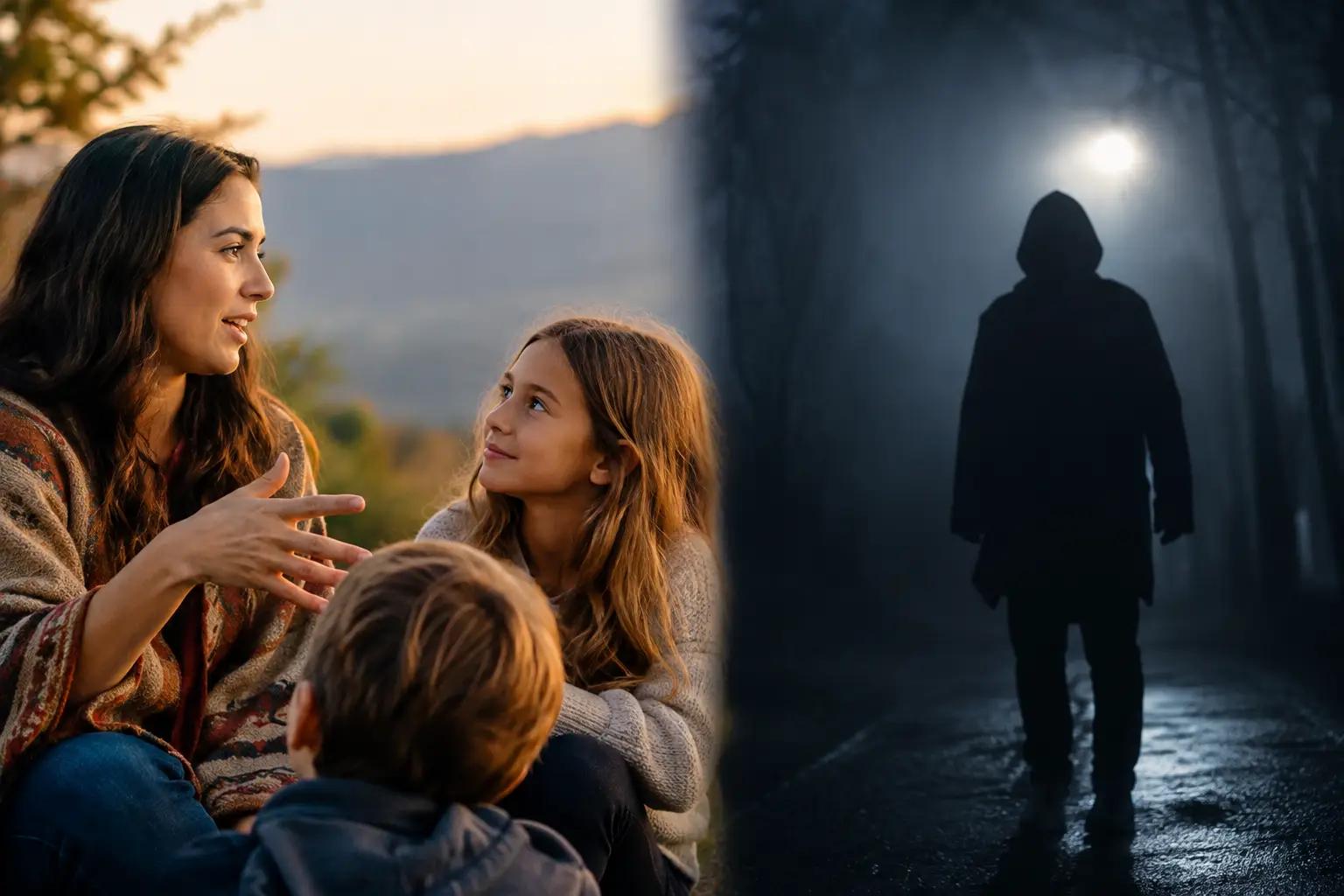
A lantern swings at the edge of an Arizona trail. Someone says a hidden mine lies beyond the next ridge. Someone else warns that travelers who search after dark never come back the same. Is that history? Is it a campfire rumor? In the case of folklore versus urban legends, the answer can be more interesting than a simple yes or no.
Both kinds of stories can make your pulse race. Both can grow around real places, strange events, and unanswered questions. But they do different jobs. Learning the difference helps Junior Investigators enjoy a creepy tale without mistaking every whisper for a fact.
Folklore Versus Urban Legends: The First Clue
Folklore is the broad collection of traditions a group of people shares and passes along. It can include ghost stories, songs, sayings, games, jokes, tall tales, beliefs, holiday customs, and stories explaining why a mountain, river, or old building matters. Folklore usually has deep roots in a community. It changes as people retell it, but it remains connected to shared identity and memory.
An urban legend is a more specific kind of modern story. It is usually told as though it happened to a friend of a friend, a cousin, a classmate, or someone just down the road. It often carries a warning: do not pick up hitchhikers, do not enter that abandoned building, do not answer a mysterious message, do not trust the stranger at the gas station.
The name urban legend is slightly tricky. These stories do not have to happen in a city. A rumor about a creature stalking a desert highway or a vanished camper in the woods can be an urban legend, too. What matters is how the story travels and how believable it tries to sound.
Folklore is the big map. Urban legends are one set of mysterious tracks on it.
Folklore Carries a Place With It
Imagine hearing a story about a ghost town from someone whose grandparents lived nearby. They may describe a saloon light seen in an empty window, a miner who never left, or the sound of boots crossing a floor that no longer exists. Even if no one can prove every detail, the tale may preserve something real: a dangerous mine, a tragic accident, a lost community, or the hardships of life in the desert.
That is one reason folklore matters. It can hold pieces of local history that official records leave out. It also reveals what people feared, hoped for, and wanted to protect. A treasure legend may reflect dreams of fortune. A monster story may grow from respect for a dangerous wilderness. A ghost story may keep a long-closed place alive in community memory.
Folklore Is More Than a Ghost Story
When people hear the word folklore, they often picture witches, creatures, and haunted houses. Those are part of it, but folklore is much bigger. A family recipe made only during a certain celebration can be folklore. So can a playground chant, a cowboy saying, or a tale about why a particular rock formation has its name.
Because folklore belongs to people, there is rarely one official version. One storyteller says the lost prospector carried a map. Another says he trusted no one with it. A third insists the mine was never real at all. Those differences are not always mistakes. They show how a living story adapts to the people telling it.
Urban Legends Move at the Speed of Rumor
Urban legends tend to feel urgent. They often begin with a detail designed to make listeners lean closer: a specific road, a local restaurant, a school hallway, a date that sounds recent. The teller may swear it happened nearby. Yet when an investigator asks for names, dates, newspaper reports, or firsthand witnesses, the trail often becomes foggy.
That does not make urban legends boring. It explains why they are so powerful. They turn ordinary places into possible danger zones. A parking lot, a motel, a hiking trail, or a phone screen suddenly feels suspicious.
Many urban legends follow familiar patterns. Something ordinary hides a threat. A person ignores a warning. A shocking twist arrives at the end. The story gives listeners a safe way to practice thinking about real risks, such as talking to strangers, wandering into unsafe places, or believing everything shared online.
Unlike older folklore, an urban legend can spread across the country in days. A scary video clip, a screenshot, or a dramatic post may send it racing from one school group chat to another. Each retelling adds a detail. Soon, a made-up story can seem local simply because someone says it happened here.
Why the Line Gets Blurry
Here is where the case gets complicated: urban legends can become folklore over time. A story repeated for decades may settle into a town’s identity. Folklore can also be told with the breathless, friend-of-a-friend style of an urban legend.
Consider treasure stories in the Superstition Mountains. Tales of hidden gold, missing maps, and unlucky searches have been repeated for generations. They connect to real geography, mining history, and the powerful mystery of rugged country. That makes them part of regional folklore. But a newer claim that someone found the mine last weekend, then vanished before revealing its location, may sound more like an urban legend unless solid evidence supports it.
The same place can hold both. A mountain may have a long tradition of stories tied to its history and to the people who have lived near it. It may also collect new rumors from tourists, hikers, and treasure hunters. Separating the old roots from the fresh footprints is part of the adventure.
Investigate the Story, Not Just the Scare
A good investigator does not rush to call a tale true or false. Start by asking what kind of story it is. Who tells it? How old is it? Does the storyteller claim firsthand knowledge, or did they hear it from someone else? Does the story change every time it is retold?
Then search for the strongest clues. A historical legend might have old newspaper articles, maps, photographs, diaries, museum records, or several independent accounts. An urban legend may have many dramatic retellings but no clear starting point. That difference matters.
Be careful with evidence that only looks official. A grainy photograph can be edited. A mysterious video can lose crucial context. A website repeating the same unsourced claim is still one claim, even if ten other sites repeat it. The most exciting answer is not always the best answer.
At the same time, do not toss aside a story just because it cannot be proven. Some legends are valuable because of what they mean to a community, not because every supernatural detail can be checked. The question may shift from Did this happen exactly as told? to Why has this story lasted?
That is the kind of question that can lead from a campfire tale to real history.
Respect Is Part of the Investigation
Not every story is ours to retell however we like. Many American Southwest legends are connected to Indigenous nations, families, sacred places, and living cultural traditions. A respectful investigator learns who a story belongs to, avoids treating sacred beliefs as spooky entertainment, and recognizes that public versions may leave out important context.
This is especially true when exploring real locations. Do not trespass into abandoned mines, private land, ruins, or protected sites in search of proof. Old shafts can collapse, desert weather can turn dangerous quickly, and artifacts should stay where they are. A mystery is not a permission slip.
The best adventures protect the places that inspire them. Carry water, follow trail rules, leave no trace, and let curiosity make you more careful, not more reckless.
Keep a Case File
The next time you hear a strange story, write down the version you heard before looking it up. Note the setting, the main characters, the warning, and the evidence the teller gives. Later, compare it with other versions. Which details stay the same? Which appear only in the newest telling? What real event, location, or fear might be hiding inside the tale?
Your case file does not have to solve every mystery. Sometimes its most valuable clue is a better question. That is how a shadowy story becomes an expedition into history, imagination, and the secrets people carry forward.
Leave a Reply